
BY SANDRA DAVIES BAKER
Copyright is held by the author.
I OPENED my business — “Choices” — on a rainy day in February, 2040. The premises were just off Bond Street in the City, wedged between a Collagen Salon on the left and a Tofu Bar on the right. I deliberated for ages on the colour of the front door — dark colours would be too sombre; pastel colours would give an air of frivolity. I wanted to exude exclusivity combined with the idea of a personal journey. So, I went for grey. With “Choices” in discreet lettering on the frosted window. I mean, I could have run the whole thing online, but I liked the idea of meeting my customers face to face. Looking back, that was probably my first mistake.
As you know, the 2040’s heralded the beginnings of AIWAR (Artificial Intelligence with Augmented Reality) but I wanted to play it old school. I wasn’t ready for that level of AI in my business plan. Hilarious when you think about how it all turned out.
You always remember your first customer. That feeling of trying to play it cool but also thinking “this is it!” Her name was Erin Layton and her brief was this: she wanted to find out what would have happened had she chosen not to marry her husband, Joshua. I make it a point not to ask why my customers want to explore their choices, but usually they end up telling me why anyway. In this case, it was fairly standard. She had always wondered if she’d made the right choice, to the point that she had looked up an old boyfriend and had realised that maybe he was the one, not Joshua. I took meticulous notes during our interview. (I didn’t need to, it was all recorded. However, I have realised that people think more carefully about what they say if they see that you are giving them their full attention.) “It’s not that I’m unhappy,” said Erin as she smoothed invisible creases out of the lap of her skirt. “I just can’t stop thinking ‘what if’.”
“Well that’s what I’m here for,” I said, wondering to myself if ‘What If’ might have been a better name for the business.
After she’d left, closing the grey door behind her with a suitably discreet thud, I got to work. I fed the details of everything she’d told me, plus my own observations into an AI algorithm that I had developed. With AI at that time, it was all about the quality of the input, and more importantly, the skill of the designer. Without sounding immodest — I was pretty good at this. And as a result, Erin — and all my other customers — would receive the story of their other life. The one they didn’t choose. They could have it as a pdf, an audio file or an old-fashioned print version. In glorious, believable detail. People, places, developments: a vivid, personal story.
I didn’t advertise. Word gets around — and I knew I had to be discreet as it’s not the best thing to discover your partner is busy reading about what life would be like without them. It wasn’t just about relationship choices though. Some customers explored an alternative life through career choices or even something as simple as what would have happened that day if they’d chosen to take the stairs not the lift. Or the train, not the bus.
For a couple of years, everything went well. I’m not going to lie, I began to make a lot of money. My overheads were low — it was just me, the algorithm and the rent for my office. And then, as you know, the tech giants released AIWAR and everything changed. Now you could, with AIWAR glasses or even a retinal implant, experience anything created by AI as if you were embedded inside it. The breakthrough changed the experience of watching a film, the news or even looking at art or listening to music.
At first, I didn’t see the potential it offered for ‘Choices’. To be honest, I was in fact resisting the temptations of this new technology. I liked the idea of creating an actual story, using words and descriptions, letting the customer use their imagination from the narrative I gave them. Then, I was approached by an AIWAR developer and everything changed.
His name was Moss and he was full of energy, bouncing around the office, waving his skinny tattooed arms around, full of ideas. I will always remember that first meeting. He’d brought his own flask of oatmeal tea and as he slurped at it, I was fascinated by the way the piercings on his face seemed to pulsate as he swallowed. When I remained sceptical about using AIWAR, he offered me a free trial — I could test out the new software with something I’d already programmed for a customer.
After he left, I leant back against the green cushions on the office sofa and took some long slow breaths. It took a while to calm myself down, as I knew exactly how I was going to test drive this new technology. Years ago, when I first started Choices, I had programmed a “what if” story of my own, to assess the business model. When I was 21 on my gap year in the US, I’d caught a bus to New York central station and randomly sat next to a girl called Becca. We ended up travelling together and working in a bar in Miami. But I had often wondered — what if I’d sat next to someone else? Where would I have gone? Who might I have met? I put these details into my algorithm to see what it would come up with. And here’s the thing — I never looked at the outcome. I ended up using an actual customer as a guinea pig. I just didn’t want to know.
But now, I really wanted to turn that unseen narrative into an immersive experience. I was totally fixated and excited by the idea.
It took me a while to get to grips with the software, but soon I was ready: AIWAR glasses on, my heart beating. And, oh my word, it was instantly, incredibly real. I was there in the grimy echoes of that bus station, making my way towards the ticket office, sidestepping bundles of homeless people. I found myself asking for a ticket to Chicago — it was weird, I had no control over what I said. And then my new story just unfolded in front of me. There was no option to fast forward or rewind. It was all in real time. And when I finally pressed ‘pause’, I was almost surprised to be back in the office, on the hard green sofa. It was now dark and cold — I’d been watching my alternative life story for about 6 hours.
Without hesitation, I called Moss. He whooped loudly when I said I wanted to use the technology. We worked on a business plan for a few days and then relaunched ‘Choices’.
It wasn’t long however, before I became greedy. Not for money at this point, but for the options available. I’d decided I didn’t like the Chicago storyline that the AI created for me and asked it to create another one. And then another one. I mentioned this new fascination to Moss one day as we sipped our Oatmeal tea (not bad once you get used to it) and his eyes lit up. “Leave it with me,” he said as he bounced out of the office.
This conversation resulted in AIWAR+ — a new product whereby you had the option to change the narrative that you were given. Of course we charged more for this. And as expected, it was really popular.
But here’s what happened: people were so enthralled about this concept of seeing the consequences of their life choices, they would wear their AIWAR+ glasses or implant all day. You would see people sitting in coffee shops and parks, immobile and vacant. Why live a real life when you can live a better one created by AI? The more we upgraded the program, the less engaged people were in their own lives. That greed that I mentioned earlier became a thirst for money and manipulation. For example, Moss and I soon offered an exclusive (and expensive) Gold option, whereby you could program a life choice thread that led to guaranteed fame and fortune.
It snowballed and snowballed until it became an avalanche. People were forgetting to eat or sleep or look after their children. This gentle form of escapism became a nasty addiction. In some cases, people using the program developed an inability to distinguish real life from the many alternatives they could live out.
And that’s why Moss and I have ended up here, in HMP Wandsworth. Awaiting trial for incitement to violence. After the Government decided to intervene in 2050 and ban the software that we’d developed, there was a national outcry. Which developed into riots. Which, I am ashamed to say, Moss and I encouraged. Everything we’d worked for looked set to disappear. The idea of losing our lifestyle and our power was not something we wanted to consider. We had got to the point that we were so immersed in our business, we genuinely believed we could do whatever we wanted. After all, if we didn’t like the way things were turning out, all we had to do was reprogram a different outcome.
So, that’s what we’ve done.
Or have we?
***
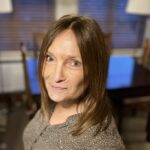
Sandra is originally from Wales, but is now based just outside London, U.K. A retired English teacher, (also a former journalist and copywriter), she writes in all genres but has a particular fondness for speculative fiction. She spends her days reading, running and writing — one day she might even finish her novel!

What a great concept! (And well-executed also.)
Get back to work on that novel!
Such an enjoyable story, Sandra! And the weird thing is that all of it is entirely possible in our future.
Interesting perspective of how AI could impact our lives!