
BY TAMARA MADISON
Copyright is held by the author.
Note: It’s 1976. 21 and newlywed, I find myself eight months into a stay in the USSR. My husband and I are working for the U.S. Department of State, “telling America’s story to the world.” It’s an exhausting time, and a strange way to begin a marriage.
I.
Time stands still in winter;
only the clocks keep track.
There’s no day, no night, just
work or no work. Friends visit
at midnight, in the morning,
in the afternoon, drinking toasts
to everything: women, love,
friendship, vodka. It’s always
black outside, shiny from rain,
sleet, warming snow; the river
where Rasputin met his death
is sluggish, almost still. Snow falls
and doesn’t leave. On the corner
there’s a phone booth
encased in ice, filled neck-high
with old snow. Parents
take their children, bundled
like space men, outside to play
in the dark. Days are opaque
with black tea and vodka
and every day I feel a little sick.
II.
My life before was often plagued
by too much sun; now I feel
menaced by darkness. We never
see the men who follow us,
the ears that listen to us
in our room, but we know
they are there. Our luggage
no longer locks, and we can’t
be sure any Russian friends
are really friends except the pair
we meet with secretly. She’s
with child, and I don’t tell her
what I fear is growing in me.
III
Nausea has kept me in alone.
A woman knocks at the door.
She is beautiful and shares
my name. She asks if I can mail
a letter for her to a professor
in the States, mentions tickets
to the ballet I’ve been telling
my husband I want to see but
the box office always says
is sold out. This woman is not
brave for coming to an American’s
room in a tourist hotel; she
is at work. Now I remember her,
stumbling from a bus
the day before, breathless
to meet me. I see now
that I’m an assignment. I know
not to trust her but am glad
for her company. I make us tea.
IV
The city is clotted with cold,
its people moving slowly like
the Neva’s icy water. It isn’t safe
to speak one’s heart or let
one’s mind move freely here.
I know this feeling. Often
my husband shows me
how wrong my feelings are,
how weak my thoughts.
But I feel safe giving my mind
to the page. I feed paper
to the typewriter, begin
to beat the keys, every sentence
a hail of gunfire. He rushes
to me, asks why, why?
I spill over like a shot glass
loaded with too-much vodka.
V
Alone on the night train to Moscow,
rolling through slick black
to a morning forest of white
Sun rises to the music
of Tchaikovsky piped in
to waken sleeping travelers.
Tea steams in a glass on the table,
but my stomach will not have it.
My breasts are heavy strangers
on my chest.
Lace curtains sway
to the rhythm of the train.
A landscape of ice rivers
covers the window.
Beyond the ice-etched glass,
snowy woods conceal
foxes, wolves, mink, elk
and I’m afraid
of what’s concealed within
my body’s strange new landscape.
VI
In Moscow I am alone with a shopping list
for the commissary and an appointment
with the embassy doctor. Yes, he tells me,
I am pregnant. Again, the darkness.
In my mind, I see my husband pontificating,
impatient, all-knowing; imagine being yoked
to him, vulnerable, dependent. I don’t want
to have this weight on my future,
want the illness removed. The doctor
makes me an appointment in Helsinki;
the visa will take some time. I go back
to Leningrad where the smells of sausage
and dirty cigarettes disgust me. I grow
breasts. One night while playing cards
the Croatian electrician asks with his eyes
my husband’s permission, reaches
across the table to caress the swelling mound
of my breast beneath my yellow sweater.
I don’t blame him, really. I like it too.
VII
In Helsinki it’s two days until Christmas
and everything is bright in spite
of the darkness. The kind doctor
wonders why I need to do this,
why I had waited so long.
I can’t explain it to him, I just know.
The nurse puts a needle in my arm
and I think What if it doesn’t work
and I’m awake for this monstrous act?
But I wake to the smell of coffee
and cinnamon. The nurse brings me
cookies. In the evening we go
to dinner, the girl who came
with me for a root canal and I. We eat
roast chicken and salad — real food —
and raise a toast to the west with mugs
of German beer. Things are bright,
we are happy, and I am saved
from an invasion. I will never have regrets.
VIII
It’s midnight when our train
stops at the border. An officer
knocks, asks if we are bringing
any goods. Vegetables! I croak
in sleepy Russian. My companion
hushes me: Scarves she says,
We bought some scarves. Who knows
what trouble a kilo of cauliflower
and a bag of broccoli might cause?
IX
It’s still dark in Leningrad,
damp and gray. One afternoon
the sun crowns the horizon
for a moment and slinks
back down. The days
grow longer by the minute.
Just a few more weeks
until we leave. I have seen
the ice-choked canals,
the Admiralty’s spire.
I have visited the Hermitage
with its famous paintings.
I have gotten drunk with artists
and politicians. I have danced
at parties with dissidents
and KGB alike. And always
I have acted like I’ve seen it
all before, afraid to bare
my ignorance, my innocence,
before my brilliant husband.
***
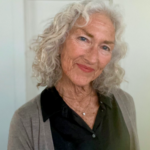
Tamara Madison is a California native and retired educator. She is the author of three full-length volumes of poetry, Wild Domestic, Moraine (both from Pearl Editions) and Morpheus Dips His Oar (Sheila-Na-Gig Editions), and two chapbooks, The Belly Remembers (Pearl Editions) and Along the Fault Line (Picture Show Press). Tamara’s fourth full-length volume, Russian Honeymoon, is forthcoming from Fernwood Press. Her work has appeared in the Writer’s Almanac, Sheila-Na-Gig, One Art, Worcester Review, and many other publications. Read more of her work at tamaramadisonpoetry.com.

Oh wow! I thought it would be shades of Billy Joel’s classic song. I got to visit Leningrad just as it was changing to St. Petersburg (1993-94). Thanks for sharing your poem!
I love the spy angle and am intrigued, but I am sad that you seemed to have to go through quite a lot on your own with your own thoughts. You seem like a person of strength.