
VALENTINES WEEK 2026
Second-place winner:
BY ANNE LICHTENWALNER
Copyright is held by the author.
IN THE weeks before Artemis died, Elmore often lay awake, a slender bridge of blanket between them. He stared out the window’s wavy glass at the cold moonlight lying upon 120 worn-out acres. What had been a warm mound, his Artemis, was all edges now. While he had feared her loss, it now seemed necessary, an inevitability. Even her smell had become sharp, like scorched plastic. He guessed this thing would eat her up soon, the cancer.
Elmore lay there, ribs starting to ache, trying not to turn over for fear of waking her. It was as if the morphine that gave her thick, gasping sleep had infused him with a jumpy version of her old vivacity. Things got stuck in his mind these nights, things from magazines read in the waiting rooms of doctors’ offices. Things like the ancient Chinese tombs at Xian. Now that was a sight- acres of red Chinese earth lying fallow over vast riches, over red clay troops, red clay horses buried standing. Standing perfectly still, accompanying the dead, some emperor or other. But then again, Elmore wondered, could the never-living ever be of any comfort to the dead?
Elmore lay unmoving, staring at the dim silhouette of an empty ridge, starless against the vast dark winter’s sky. Air and ground seemed all of a piece in the moonlight. Perhaps that distant Chinese ground had lain for centuries, covered by barren moonlight, featureless and peaceful. He tried to stay like that, perfectly still, for Artemis.
He had never not tried, not in his life. Hell, they’d both tried. From that first dance together — touching her waist in the flare-skirted dress — they’d tried for weeks to find a quiet place to settle down and test again the fit of their noses against the other’s face, to try again the taut hooks of the starchy back of her bra. That trying succeeded in getting them to the altar in the town of Othello, his pickup bouncing over the dirt road from Kahlotus, an hour away. And then they inherited his folk’s place, a few beef cattle, pigs. He tried raising hay, but in the scab lands of Eastern Washington, the rains were stingy. So, early on, Artemis took a waitress job at the truck stop in Washtucna.
Weeknights, she came home flat-footed with fatigue. Still, when he took her to the city, to Spokane, she always walked with a quick, stylish step, swinging her purse held halfway down its straps. No children. Maybe for her, it was the fatigue, at least for the 20 years until the I-90 came through and they closed the truck stop. He struggled alone with the calving and the farrowing, with fixing farm machinery; yes, maybe it was the fatigue itself was the contraceptive. They said all women wanted children, and he hadn’t given her one. He was a good man, didn’t smoke, or drink more than the regular beer, and he damn sure never ran around. She had been such a pretty girl, though, and what had he given her?
He got up from their bed and walked through the moonlight carefully (as the floor had a groan) into the kitchen, opened the cupboard. His hand found a glass and he ran some cold water into it slowly, so the pipes wouldn’t rattle. The moonlight lay in a bar upon the open cupboard. On the very top shelf, delicate, with tiny wings sprouting from its back and a red-lipsticked mouth, was that porcelain pig. It stood, front legs akimbo, on its hind trotters. Like a fashion model, but smaller than a breadbox. The robust belly hung forward, pale and luminescent, as if pregnant.
Elmore had given it to Artemis for Valentine’s Day 10 or 15 years ago. He’d gone into the only real jewelry store in Spokane, although the prices on the tiny white tags made his stomach hurt. He was afraid to ask for assistance, though he was wearing his suit at the time. The farming smell just didn’t go away that easily. The pig, ridiculous but fragile, at least seemed familiar. It was probably the least expensive thing there, but still more than he could really afford. He’d compromised by taking Artemis out to dinner at the fried chicken place instead of somewhere really nice.
When she saw the jewelry store’s label on the gift-wrapped box, she went a deep, tender pink and her eyes lost the tightness around their corners. Elmore leaned forward. Artemis opened the box, parted the tissues and her face went blank. He laughed, just one awkward squawk. She got white around the mouth, gave him a quick kiss and said, “That’s real nice, honey.”
Elmore set the water glass in the sink. He’d do the dishes in the morning. He had time on his hands, since he’d sold off most of the cows and all of the pigs. Time to clean out the sheds, time to fix the fence that might never hold more stock, time to tend Artemis when the lump in her belly turned out to be a tumor. He didn’t know whether she had been made a captive of his care in order to turn the tables for the years of feeding, cleaning and looking-after she’d given him, or whether there was just no real plan in any of it. But he felt lucky to have the chance to somehow redeem himself, and had held to some hope — through the surgery, the hair loss and the vomiting that followed, the prolonged time of mending and hope wherein she seemed to reach a stage of waxy friability from which she never emerged — that this reversal of care was only temporary.
***
Now, a month after her death, the moon was hanging again over the low, substance-less ridges to the south. Elmore lay, vigilant, under the blankets and also every coat in the house because without her the bed seemed so cold. The weight of the covers was comforting. He lay and thought of Kamiak Butte, hours to the east, of how the moonlight must be spilling out onto the snow along its long flanks spotted with bitterbrush. Years ago, they’d hiked to the top of it. Artemis stood atop the pile of rocks on the very summit for a summer midday hour. The wheat fields of eastern Washington, the Palouse, lay in glowing gold abundance for miles around the ancient mass of the butte.
“They’re made of dust,” he told her, reading from the bronze plaque beside the trail. “All of them wheat fields, darned if they aren’t hills made of dust. The dust blew, hundreds of feet deep, and this old mountain almost got covered up!” He shook his head, thinking of the vagaries of wealth. He was staggered at the richness of it, the wheat, still and sunlit on the backs of the undulant hills surrounding the rough outcrop of Kamiak Butte. Artemis stood on the rocks above him, skirt blowing away from her knees, her white Keds dusty on the granite stone.
“It’s an island,” she breathed into the quiet air. Her face was as bright as he’d seen it in years. “It’s MY island. I’m the queen, the goddess of the island!” She spread her arms out wide and laughed, statuesque in Elmore’s eyes, though her upper arms quivered.
She had left him, in her lingerie drawer, a letter written in loose, painful script. “Dear Elmore,” it began. “I want to be cremated. And you take my ashes to Kamiak Butte and throw me off. And you give that porcelain pig a nice grave in Kahlotus. Love, A.” So he’d done just that, though he wanted a grave to go to, a place where he could sit with her. It had taken him all day in the old Dodge pickup to get to Kamiak Butte. He’d stopped in Washtucna because the engine was hiccupping and bought a jug of Heet to dump in the gas tank in case there was water in it. It had gotten him to Pullman. Pullman had been covered in snow, the college still closed for the Christmas holidays, so the town looked cold. Cold and dead. He drove slowly through it, then out through the steep-sided wheat fields.
Kamiak Butte park was closed, the sign said. He parked the truck aiming downhill in case it wouldn’t start again, and climbed stiffly over the candy-striped barricade. Artemis was in a can, and he could hear her harder parts clicking against the metal as he walked. She fit under his arm just fine, like always. He couldn’t picture her in the can, but rather looked around him. The size of those trees! The trail was longer than he remembered, snow frozen into a slick crust in the shady parts of the trail. At least 10 years since her day in the sun, could things have changed much? But he found the cairn of boulders at the top just at dusk, and climbed it in his barn boots and coveralls.
The wheat fields were now stubble against the sifting of snow, and covered the thousand hills like a legion of crewcuts. Against that dull gold and white background, the steeper slopes of Kamiak were etched with sage and bitterbrush, with conifers. What snow had fallen on the southern face was gone, and the rocky open slope was dark in the sparse light. He thought about taking her back down, finding a hotel room in Pullman, and scattering her in the more hopeful morning after a last night together. He was self-conscious at the thought, and stood with one hand set to unscrew the lid for a long moment.
It grew darker and he became aware of the cold, growing like roots into his knuckles, cheeks and teeth. The western rim of the sky grew lemon-pale, and the low, dimpled clouds gave birth to flakes. In the sifted silence, an owl’s cry was harsh and sudden: “To who? Who? To whoooo?” Elmore startled, and his hands moved on their own, the lid flung whinging onto the stones, all that was left of Artemis a slinging arc of dust against the pale slab of light remaining on the horizon. Grit in his teeth and eyes. He blinked, tearing up, and almost spat, then ran his tongue along his teeth and swallowed. He straightened up and waved goodbye, then his shoulders fell and he turned to begin the long walk back.
His truck ran fine all the way home. Even the heater worked. He drove slowly, pushing along a hollow of noise and headlights through the empty night of the Palouse. By the time he got to Kahlotus he was listening to the Farmer’s Report and the light behind him was strengthening.
Then there was the business of the pig. He thought she wanted it to have a regular grave and a headstone, but not only was it quite expensive, they wouldn’t let him bury a porcelain pig in the Kahlotus cemetery. So he used his posthole digger and carved out a grave in the frozen ground of the ranch, in view of the kitchen window. He had a granite slab carved in Spokane.
The pig was three feet deep in a cardboard casket, and the sky was holding off, too cold to snow, on the day he drove to Spokane to pick up the headstone. “Artemis Leopold,” it read. “1929-1998. In memoriam. Beloved Wife and Goddess of Kamiak Butte.” He didn’t know quite what had come over him, but as he stood and looked at the sharp angles of the letters, he felt sure that he had it right. The slab weighed over three hundred pounds, and they used a winch to lay it on top of a sheet of cardboard in the pickup bed.
“It’s fragile,” said the salesman. He had on a suit. “You’ll need a come-along to unload it. You can use furniture wax to keep it looking new.”
Elmore picked up a can of Pledge on his way out of town, although he had never polished a thing in his life. It was comforting to think of rubbing a rag against the slick surface of the stone, of keeping the letters clean with Q-tips. He drove out of Spokane’s sprawl and into the rocky flats of the scab lands, rimed with remnants of windblown snow. The old truck’s radio came in clear, even out here, no doubt due to the heavy cold. Elmore dialed in the news. The announcer’s cultured voice filled the cab, her lilt slightly British. How Artemis’ voice had flattened, but how round it had been when they met. How did a man iron out a woman so?
“The total has come to 34, and authorities are still searching for more bodies,” the bodiless voice recounted.
A male voice added, “Similar killings have happened before. Usually, it’s one of the ranchers around Reno, tired of having the wild horses ruin their crops.” Elmore stared farther than the road ahead, saw a different horizon.
“This looks almost like target practice, though,” said the woman’s voice.
“Yes, but some are far from the highway. It looks like only one gun was used, and the shootings were quite methodical —” Elmore snapped off the radio, but the voices stayed in the cab.
Maybe that’s what he should do. He could go there himself, to Nevada somewhere, for those horses. They wouldn’t be wasted. It seemed very clear to him. An army of horses, nearly, buried standing. Heads outstretched, manes suspended in the packed earth. She had a pig, that was a start. He would happily give her horses, was giving her the spirits, at least, of 34, count ‘em, 34. He almost missed the turnoff for Kahlotus, thinking of the possibilities.
***
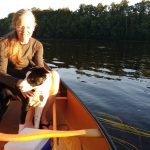
Anne Lichtenwalner is a retired veterinarian living in Maine, U.S., after a career spent in the Pacific Northwest, the Caribbean and the Northeast. She is kept in line by her hard-working Border Collie, Bernie. Her writing deals with women’s identities and autonomy, but animals seem to sneak into every story.