
BY JACQUELYN LYON
Copyright is held by the author.
I NOTICED it when I was in third grade. We had this globe on my father’s desk from the 1990s, painted in faded blues and browns and labeled in barely legible cursive. My father got a kick out of things that were slightly wrong or outdated or nonfunctional in the regular sense. This map in particular still had the Soviet Union in one piece. Arkansas was misprinted as “Arckansas,” which he loved, and they forgot to print half of New Zealand. It’s almost impressive at that point when you manage to forget half of an entire country.
I used to sneak into his office when my mom was on the phone with her friends and my dad was at work and ran my hands over the smooth plastic topography. I traced the peaks of the Rocky Mountains and dips of the valleys in India and the dark line of the Marina Trench. I was a hands-on child: plunging my hand into the sandbox to feel the granules, threading my fingers through my mother’s hair when she’d let me, finger painting in long watery strokes.
My dad’s office had a hazy late afternoon-feel, the dust and sun and the smooth plastic mountains putting me in a trance. My eye caught on something. A round dot sat in the middle of the Soviet Union. I frowned, studying the dot like you might wiggle a loose tooth with your tongue. Darker and rounder than the rest of the map, it was next to the printed word “Siberia.”
The front door slammed, and I went back to tracing the Himalayan mountains. I knew even by that age that my father’s old globe wasn’t to be trusted — it was missing half of New Zealand after all. So, I ignored the dot the first time.
***
We were doing a unit on the countries of the world in fifth grade, and it became impossible to ignore. Our teacher dimmed the lights and projected wall-spanning maps on the screen.
We were placed into groups of four to do projects on the wildlife and food of different regions, I was assigned Australia with a group of boys I didn’t even like. They always paired me with the loud kids in class as if I would rub off on them. The second day of the unit and my eyes were hot glued to the corner of the map.
I raised my hand and sat up perfectly straight. Mrs. Stevenson paused in her explanation of how exciting the pyramids were and the seasons of the Nile River and pointed at me. I rarely raised my hand in class. She beamed. “Yes, Astrid?”
I folded my hands in front of me and shifted in place. I had practiced the question in my head several times. “Excuse me,” my cheeks warmed at the sound of my own voice, “but what’s that spot on the map?” I pointed to the perfectly round smudge that shouldn’t have been there in the first place. The mark was small, but very dark and it had started to bother me the second she put it up the day earlier.
My teacher’s brow folded in. “That’s Russia,” she said, following my pointer finger.
“No,” I said, stubborn, and jabbed the air. “Inside of it.”
“Oh.” My teacher clapped her hands. “That’s Siberia. Siberia is a large swath of land in the north with a wide range of natural habitats, including the tundra and the deepest lake — ”
“No.” My voice pierced the air, and several heads whipped around to look at me. “What’s that dot in Siberia? The big black mark.”
My teacher’s mouth twitched, and she stared back at me for a long moment. She smoothed her skirt down. “We have to get back to Africa now, Astrid,” she said coolly. “If you have any more questions like that you can ask me after class.”
I folded in on myself, glancing around and hoping to catch someone’s eye. I had seen students exchange looks before about unreasonable teachers. I was met by a chorus of whispers instead.
“What is she talking about?” someone hissed to their neighbour, and I bit down on my cheek.
I asked my only friend in the class, Kelsey, about the smudge later. She said there was no such smudge on the map. That was somehow the worst possible answer.
***
I became briefly obsessed.
I stopped and stared at maps on advertisements and cereal boxes and thrift store mugs. I bought a world map at the local mall. I snuck onto my family computer and googled it over and over again: Siberia. Siberia. Siberia.
They were all the same. There was a hole directly in the middle of nowhere as far as I could tell. I would have dismissed it, maybe my globe in my dad’s study was misprinted, maybe I was just seeing things that day in class, maybe I had an eye problem.
But every single map I looked at was the same, it wasn’t a city, it wasn’t a mountain, it wasn’t any kind of landmark according to databases. It was just an empty spot.
I wrote school projects on Siberia. I looked up tundra topography and conifer forests and how much snowfall the region received and what kind of animals and people lived there. Most of it was average information such as fun facts (there is a diamond mine so large in Siberia that helicopters are not allowed to fly over for fear of being sucked in!) and the type of currency used (rubles) and spoken languages (a lot).
I wasn’t sure what to make of it. I was sure I was sane, at least at that age I was sure, but there was no explanation I could find.
“You don’t see it?” I asked my mom one day over breakfast as I pointed to a map in my textbook. I pointed right at the dot.
My mom looked over her shoulder. “Oh, this again,” she tutted, “you want us to take you on a trip, is that it? You’re just like your dad. We can’t afford anything like that right now.”
I knew by then that mom wasn’t seeing anything. I didn’t know what everyone else saw, but somehow, they either didn’t care about the blank spot on the map or couldn’t see it.
***
Over the years, my obsession with the black spot flared and cooled like a chronic headache until it became concerning. I was in the eighth grade and the spot gnawed at the back of my mind.
I was on a school computer, skipping lunch to finish an essay for LA. Two girls next to me babbled, breaking my concentration every time I managed to finish a single sentence.
“It’s called the airport game,” Miranda Green was saying to her best friend Haley. Best friends are always suggesting things to each other. “You drop yourself off anywhere on Google Maps and then try and find your way to an airport.”
Google Maps had come out a few years before, like Map Quest but grander. I glanced at the two of them. I was halfway through a meandering thought about The Tempest’s distinction between men and monsters when I opened a new tab. I typed in a new URL with jittery hands, as if someone might try to stop me. I wasn’t allowed that much computer time at home — especially after my mom discovered my repeated searches about mass hallucination and population-level delusions.
The website loaded in granules. Chunky colours and shapes took form one pixel at a time and hunched over with each splash of green or blue. I spun the little map around with my mouse and zeroed in on my favorite location.
Just like physical maps and online maps and maps painted on the walls of indie coffee shops: there was a hole. I started zooming. Each loading period seemed longer than the last, the green pixels popping up one by one.
The closest town to the spot was “Yakutsk” and there was nothing, empty space and a distant blue splash representing a lake.
I zoomed until the colours of the map disappeared and the words smeared and the screen went cool and black. It wasn’t like it turned off. Blacker than black — smooth and shiny and strange, the screen disappeared.
It was depthless, feelingless, empty black.
“Astrid!” I jumped at the sound of my name. “Are you just sitting there? The library is closing.”
I turned left and right and the lights in the library were dimmed and the two students sitting next to me were gone. The solitary librarian stood over me with hands on her hips. “How long have you been here?”
I glanced out the closest window and realized the sun was setting. I jerked to my feet. “What time is it?”
She shook her head. “It’s almost 5pm, were you playing one of those online fighting games? The boys always manage to crash the computer with those. Do you know how long reboots take?”
I looked down and the computer featured a large blue error screen. Crashed. Maybe crashed hours ago.
“I have to go.” I reached for my backpack, cheeks burning and thoughts spiraling. My mom would have been trying to pick up two hours before.
I had missed turning in my essay. I had missed my afternoon classes. I had been sitting at that chair staring at that screen for apparently five hours.
I stopped searching for the spot after that.
***
I avoided looking at maps in high school. I placed myself purposefully in the lowest social studies classes and disengaged with world history.
My time and energy were wearing thin by that age with little left over for mysteries. I kept my head down and I tried to do what I had always done: not stand out. Make sure no one could tell I didn’t know how to answer them. Make sure no one could tell I didn’t know how to start conversations. Make sure no one can tell you’ve never held a hand or kissed someone.
I think I lied more often than I told the truth in those painfully slow years. “I’ve course, I’ve been on dates,” I laughed and said to my locker-mate. “Of course, I’ve had friends sleep over at my house.”
I knew people casually and didn’t know them at all.
My mom was worried. She orbited around the same questions, when are you going to bring a friend home? When are you going to bring a boy home? When are you going to try a little harder, Astrid?
I was trying as hard as I could, busy tucking and creasing and folding into myself like a well-made bed. Walking across that graduation stage at 18 was the largest relief I ever experienced.
***
It was just my luck that my college roommate was an international studies major. I had almost forgotten about it by then, willfully so. She hung an enormous map on her side of the room, and Wendy Jackson spent her first day pressing red and golden stars to it. The red stars represented places she had been to, and the golden stars represented places she wanted to go. The map was absolutely covered in them.
As far as I could tell, the dark dot in Siberia was also just there to annoy me. I sat on my bed and pretended I wasn’t staring at it. Wendy Jackson lay on her stomach and typed on her laptop.
My heart squeezed and I couldn’t tear my gaze away. “Hey,” I said, and Wendy’s eyes floated toward me. We hadn’t spoken much in that first month and her polite attention focused on me for what felt like the first time. I toyed with my next words for a full minute before they spilled out.
“Do you think everything in the world has been mapped?”
She sat up in bed and shot me a funny look. “What’s that?”
I looked away. “Nothing. I was just looking at your map. Thinking stuff. About mapping.”
She gave a lopsided grin. “The process of is pretty cool, I bet. I mean, we’re not even done yet, like, only like twenty percent of the ocean’s been mapped.” She put her laptop away; she always was a talker. “We know more about the moon than we do our own oceans, which is crazy, right? Since the ocean is like, most of our planet.”
I nodded and shifted in place. “Right, yeah. Plus . . . other places, on land even, somewhere we don’t know. Do you think some can’t be mapped? Even with satellites. Like places that no one’s seen before. That we’re not supposed to see.”
“What are you talking about?” She was definitely giving me a funny look now.
“Nothing, really.” I pulled back. “Just thinking out loud. A little philosophy.”
“Uh, right.” She flopped down on her stomach. “Hey, what’s your major again?”
I leaned back against the wall and stared up at the ceiling. I closed my eyes. “Architecture.”
She must have something like “cool” or “nice” after that, but I was still thinking about holes and gaps and empty places of the world.
***
It was easy to forget. It was easy to get lost in my life: the classes and passing faces and trying to play the conversation game even when it felt like I was never winning.
I did meet someone. His name was Josh, and he was in law school, he wore vests with button-ups and had long shaggy brown hair and played two instruments. I think I liked him because he was the sad type and we could just sit and be sad about the world together. I liked the way he looked at me. I liked the way he liked me. For a long time, I thought that was enough.
We moved in together after college and I couldn’t help but start to ask myself — is this what I wanted? Is this what I was supposed to want? Was there a road map to the “after” part of my life? After high school and after college and after finding someone.
My mom was pleased. She loved Josh and fussed over him every time he went to the house. She was getting divorced from my dad and it was hard for me to visit them without Josh. I felt like an unmoored buoy every time I noticed how they didn’t look each in the face anymore.
I began to dream that second year we lived together. I was working at a high-end grocery store because I couldn’t find any jobs in my field, and we were planning on getting a cat. I loved cats. A cat would make things better.
Summer had engulfed our neighbourhood like an open mouth, turning the bed sheets into a nightly sticky mess. I sat bolt upright around 3am, twisted in the damp covers and panting like I had run a marathon. “Oh God.” I buried my face in my hands. “Oh God.”
Josh turned over and reached for me. “What’s up?”
I batted his hands away. “Something.” I mentally grasped at the dream, but it slipped away like water through my hands. “I was dreaming about it.”
“About what?” He put his glasses on and seemed fully awake.
I tucked my arms and legs into myself and rolled my knuckles over my sternum over and over. “Something,” I repeated. “Nothing.” The centre of my chest was cold to the touch.
***
It was my third year with Josh and second year after my parents’ divorce. I was getting sick of having the same dreams I couldn’t remember. I was sick of packing food for snobs, and I was sick of living in a one-room apartment with shitty air conditioning. We never got that cat.
I sat on the couch and pulled up a map on my phone. Google maps had only gotten better and better. I went onto the street view near the city of Yakutsk and started going in any direction.
The roads went on and on through faceless forests and narrow empty spaces, yellow hills and roadside houses. I scrolled until my thumb ached and I didn’t know what I was seeing anymore. I kept scrolling. Keys jangled in the door, and I snapped my head back. The apartment had grown dark.
“I’m home.” Josh spotted me on the couch and gave a creased smile. “Having fun on your day off?”
I looked at my phone, and the battery had died. It might have been dead for hours.
I curled up into myself. “Not my day off.” I surprised myself with the truth. “I called in sick again.”
Josh frowned and made his way over to me. “Having another shitty day?” I just shook my head, and he took a seat next to me, but not near me. “Can you tell me what’s wrong? Like, actually wrong.”
Me, I wanted to say, it’s always been me.
He put his arm around my shoulders and kissed my temple and then seemed to wait for me to answer.
“Do you ever,” I attempted, dipping into the crevice inside myself and trying to dig it out, scoop it out, force it out and leave it bleeding and open on his lap. “Do ever feel like you’re missing something?”
His expression tightened, a flash of light over glass, and then cleared. He kissed my temple again. “Of course.” He chuckled. “I was missing you before I met you.”
I should have felt warm in my chest. I should have felt like I could put down that gnawing feeling in my gut.
I turned toward him and tried to smile. “Very cute.”
“You’re cute.”
Feel it, I ordered myself as he helped me stand and stretch my cramped legs. Feel it, I growled at myself, Love him already, dammit.
If I had been paying attention those thoughts were the beginning of the end. He never really did understand.
But truthfully, I didn’t know if anyone was going to.
***
It was Thursday. It was raining. My bank account was zero and my answering machine was full of messages from my mom.
She found out I broke up with Josh, which I didn’t want to discuss with her because it had happened months ago. I sat in an airport terminal with my back straight and my only luggage a baby blue backpack with a broken zipper.
A little girl the size of a melon played peekaboo with her father. A businessman in a suit shoved a phone to his ear and demanded answers. A woman whispered in Russian to what I assumed was her grandmother and patted her hand.
Kids passed. Security passed. Old men in wheelchairs passed. They kept making announcements over the loudspeakers and I kept drinking more water despite not being thirsty anymore. I tossed my phone in the trash. I tossed my keys in the lost and found.
I boarded the plane without looking and put earphones in the second I sat down.
I don’t remember the plane ride well. Or the train ride, getting yelled at in Russian several times, the taxi I barely managed to snag. Time flickered past like a picture show with the sound turned low and colours muted.
“You sure?” the taxi man asked, dropping me off in the middle of a dirt road. “Nothing out here.” I waved my hand absently and handed him the rest of my rubles I had on me. “Alright, lady.” He drove off.
I faced a clump of dark evergreens, spaced jealously apart, and branches trembling from this small animal or that. The sky was narrow and bleached overhead. Quiet quilted over the land interrupted only by the crunch of my boots on pine needles. Early October chill bled through and flushed my cheeks. I walked with a touch of fever to my movements.
The world became small: my steps and my breath and a distant dizziness that I pushed aside. I nibbled on energy bars, strode through the dark and the mud and past lakes and streams and nascent deer with their ears flicking back and forth.
My fever broke with the light. The sun ghosted over the treetops and my body ached in every possible way. I shouldn’t have been able to hike through the night, I thought, and I wasn’t fit or rested enough. But I did.
A clearing opened up, the trees parting and grass turning blue in the early light. A handful of people gathered: a round woman wearing a large-brimmed red hat, the type you might see at the beach. A teen boy with a ripped-up black t-shirt and strikingly blonde hair. A woman with elaborately twisted hair, purple crocs, and thick glasses. A man with a long white beard, bent and skinny as a reed, stared at the sky.
A final woman in a heavy parka coat turned to me, and I shivered from head to foot. We nodded at each other. “You’ve seen it?” she asked in a dusty voice and all I could do was nod again.
There were trees ahead, just like there were trees behind me. But the pit of my stomach said there was something more too. The soreness in my muscles told me I could stop. The prickle behind my neck told me I could start walking again soon.
My whole body was singing with it, frozen with it, burning with it. The empty spot on the map was just beyond those trees.
“Sunrise,” the old man muttered, “sunrise.”
We huddled close and the woman in the beach hat tsked at me. “You almost missed it.”
I gave a soft smile. “I wasn’t sure before.”
“You will be,” the teenage boy said and turned toward the gap in the trees. “We have to be.”
The odd group of strangers, young and old, and the only ones I felt would understand, surrounded me. I apologized to my mom in my head. I told my dad I really had cared for him even if I never showed it. I told Josh that it hadn’t been him — it was me.
Someone took my hand. Another person put an arm around my shoulder. We walked as one, like penguins against the wind, I imagined. Something shivered up ahead — like the air itself was dancing. My heart thundered in my throat and my eyes went wide.
And together, we walked off the map.
***
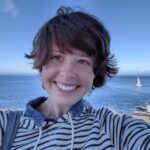
Jacquelynn Lyon is a fiction author from Boulder, Colorado. She has a number of published short story collections, writing mainly fantasy, science fiction, queer romance, and about anything that fills her with wonder. When not writing she spends her time jogging, reading, and watching her cat do a delightful number of cat-things. You can find her work at jacquelynnlyon.com.

What a lovely story, It said so much more than the length, and the ending was completely satisfying,
Delightful story. Well written. Fun ending.